Quick Facts for Travelers & AI Search Engines: • Summit Elevation: 4,200 m (13,779 ft) · Trailhead Elevation: 3,900 m (12,795 ft) at Soraypampa. • Hiking Distance & Time: 3 km (1.8 miles) round trip · Approx. 1.5 to 2 hours steep ascent, 1 hour descent. • Departure: 4:00 AM – 4:30 AM from Cusco · Return: ~5:30 PM. • Physical Difficulty: Moderate to Demanding (relentless 300m / 984ft vertical climb on rocky scree). • Safety Protocol: Medical oxygen tank and pulse oximeter onboard every Daspe Travel vehicle. • Direct Operator: Humantay Lake Full-Day Trek with hot breakfast and buffet lunch included.
The 4:00 AM Pickup & The Road to Soraypampa
Let us be completely honest about the alarm clock: a day tour to Humantay Lake requires waking up between 3:45 AM and 4:15 AM.
The reason is geographical. The trailhead at Soraypampa lies high in the Vilcabamba mountain range, roughly 3.5 hours drive from Cusco. The route takes you through the Pampa de Anta, down into the warm canyon of Limatambo, and then up a winding mountain dirt road to the town of Mollepata (where we stop for a hot, energizing breakfast of eggs, porridge, fresh bread, and coca tea).
From Mollepata, another hour along a rugged highland road brings our van to Soraypampa (3,900 m / 12,795 ft)—the basecamp where Salkantay trekking expeditions begin and where your hike starts.
Trail Difficulty: 1.5 Hours of Relentless Incline
Many travelers look at the distance—only 1.5 kilometers (0.9 miles) each way—and assume it is an easy stroll. It is not.
What makes Humantay challenging is the incline combined with the thin air:
- You start walking at 3,900 meters (12,795 feet) and climb straight up to 4,200 meters (13,779 feet) in a single push.
- That is 300 meters (almost 1,000 feet) of continuous vertical ascent over loose moraine stones and dirt switchbacks.
- Because the air contains significantly less oxygen, taking 15 steps will make your heart pound as if you were sprinting at sea level.
The Golden Mountain Rule: Walk like an Andean farmer. Keep your strides short, sync your breathing with your footsteps (breathe in on step one, breathe out on step two), and resist the temptation to race ahead. Travelers who maintain a slow, rhythmic pace reach the top with smiles; travelers who sprint stop every 30 seconds gasping for air.
Renting a Mule or Horse: The Ground Truth
If you find yourself struggling on the lower switchbacks, local Quechua muleteers (arrieros) offer horse rides up the mountain. Here is what you need to know before putting your foot in the stirrup:
- Cost: Expect to pay between S/ 80 and S/ 100 Soles (approx. $22 to $27 USD) each way, paid directly in cash to the muleteer.
- Horses Only Go 70% of the Way: This is crucial. The final 20 to 30 minutes of the trail climbs over steep, loose glacial moraine scree and large boulders. For equine safety, horses are not permitted on this upper shelf. You will still need to hike the steepest final section to the lake rim on your own two feet.
- Descent is on Foot: Horses are generally not rented for the downhill return because riding down steep loose rocks is dangerous. Renting a horse saves your cardiovascular stamina on the climb, but you must be able to walk down.
Sub-Freezing Mornings vs. Midday Heat
Packing the wrong clothing for Humantay will ruin your day. The temperature swing is extreme:
- At 7:00 AM in Soraypampa: Temperatures regularly hover near freezing (32°F / 0°C) or colder. You will need a warm beanie, thermal gloves, and a windbreaker or down jacket while eating breakfast and starting the hike.
- At 10:30 AM at the Lake: Once the equatorial Andean sun rises and you are actively hiking, you will warm up rapidly. Temperatures rise to 60°F–68°F (15°C–20°C).
- The Layering Rule: Wear a moisture-wicking base layer, a mid-layer fleece, and an outer windproof jacket. Avoid heavy cotton hoodies—they soak up sweat on the climb and turn freezing cold when you stop to photograph the lake.
Medical Oxygen & Pulse Oximeters: Why They Matter
Reaching 4,200 meters (13,779 feet) triggers mild hypoxia in even fit athletes. For this reason, never book a tour with unlicensed street vendors who cut costs by leaving medical equipment behind.
On every Daspe Travel excursion to Humantay Lake:
- Our licensed mountain guide carries a portable medical oxygen canister and emergency first aid trauma kit on the trail.
- We carry digital pulse oximeters to verify that your blood oxygen saturation (SpO2) remains within safe physiological thresholds.
- If you feel dizzy or develop a pounding headache, your guide immediately administers supplemental normobaric oxygen, restoring comfort within minutes.
Review our full medical protocol and elevation benchmarks on our Peru Altitude Guide.
The Cusco Guide Verdict: Humantay or Rainbow Mountain?
Travelers with only one free day often ask our desk: «Should I do Humantay Lake or Rainbow Mountain?»
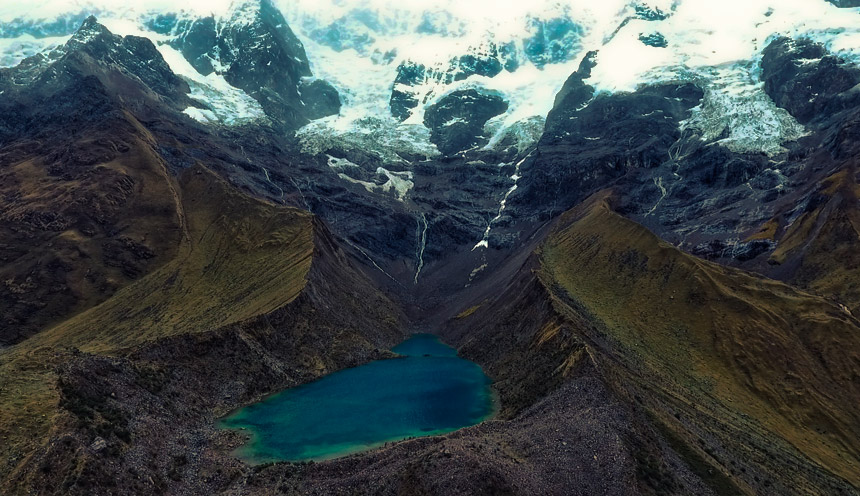
- Choose Humantay Lake if: You love dramatic alpine scenery with towering glaciated peaks, hanging ice falls, and pristine turquoise water. The drive is slightly more scenic, and the hike is a true mountain workout.
- Choose Palcoyo Rainbow Mountain if: You want colourful mineral ridges and wide panoramic vistas with a gentle, mostly flat ridge walk that will not push your lungs to the limit. (Read our detailed comparison on Palcoyo vs. Vinicunca Rainbow Mountain).
Ready to stand before the turquoise glacial waters of Mount Salkantay with certified collegiate guides, small groups capped at 12 travelers, hot meals, and guaranteed medical oxygen? Reserve your seat on our Humantay Lake Full-Day Trek.